Capturing Orion’s Belt
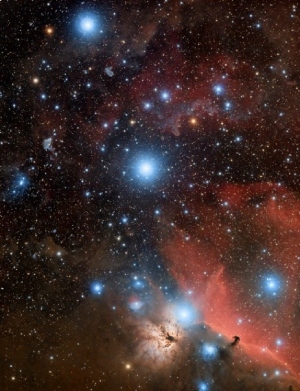
Astrophotography allows us to see details invisible to the naked eye. Long-exposure images can reveal faint nebulae, clusters, and cosmic dust illuminated by nearby stars. The region around Orion’s Belt is particularly rich with such objects, including the famous Flame Nebula, Horsehead Nebula, and other lesser-known but equally intriguing features. Capturing this area requires careful planning, proper equipment, and optimal conditions, as the faint structures demand both light sensitivity and precision.
The following image illustrates the stunning arrangement of these stars and their surrounding nebulae:
Details
- Exposure: 20×600″ + 20×600″ @ ISO 800
- Telescope: William Optics Megrez 88FD with flattener/reducer Borg DG-L
- Filter: Hutech IDAS LPS P2 2″
- Mount: Skywatcher EQ6 Pro
- Camera: Amp-off Modded & Cooled Canon 350D
- Date: 4th December 2010
- Location: Coll d’Ares (Lleida, Spain)
- Comments: It was a very cold night (-7ºC) with very good transparency and low humidity, ideal conditions for astrophotography. This is a very beautiful area of the sky, full of curious and intriguing nebular objects. This image was selected as NASA’s Astronomy Picture of the Day on January 21st, 2011!
Mintaka (Delta Orionis)
Mintaka is the westernmost star of Orion’s Belt and the faintest of the three in visual brightness. It is a multiple star system with a hot blue giant and an O-type companion. The system is also an eclipsing binary, which means that its apparent brightness fluctuates over time. Mintaka’s location at the top of this mosaic provides a reference point for observers exploring the surrounding nebulae, including the nearby dark clouds that partially obscure the background stars.
This star is more than just a bright point of light; its radiation shapes the gas and dust around it, influencing the formation of nearby stars and nebulae. Photographers often highlight Mintaka’s subtle variability to illustrate the dynamic processes at work in these stellar nurseries.
Alnilam (Epsilon Orionis)
Located at the center of Orion’s Belt, Alnilam is a blue supergiant and one of the most luminous stars visible from Earth. Despite being almost twice as distant as Mintaka or Alnitak, its extraordinary brightness makes it appear comparable in size and intensity. Alnilam is a young, massive star losing material into space, which contributes to the intricate structures in the surrounding emission nebulae.
In astrophotography, Alnilam often serves as a focal point, with its light highlighting delicate filaments of gas and dust. The star’s energy output and its interaction with nearby molecular clouds make this region one of the most photographed and studied in the night sky.
Alnitak (Zeta Orionis)
Alnitak forms the eastern end of Orion’s Belt and is itself a triple star system located roughly 800 light-years from Earth. Its primary star is a hot blue supergiant, notable as the brightest O-type star visible to the naked eye. Alnitak sits just above the Flame Nebula in images, casting illumination across dense clouds of gas and dust.
Astrophotographers often include Alnitak to frame the famous Flame Nebula and nearby Horsehead Nebula. Capturing both stars and nebulae in a single composition requires careful exposure balancing, as the bright stars can easily overwhelm the faint surrounding structures.
📷 Why Photograph Orion’s Belt?
Photographing this region provides more than beautiful images. It’s a way to engage with the cosmos directly, understand stellar evolution, and explore the interplay of light and matter in our galaxy. Orion’s Belt serves as a gateway for both amateur and professional astronomers, offering familiar markers and endless opportunities for discovery.
A Celestial Icon
These three stars, Mintaka, Alnilam, and Alnitak, are some of the most photographed and surveyed stars; Mintaka, on one side, had an identification with whom stargazers abstained from destroying all sorts of earthbound atmosphere. Their brilliance, surrounding nebulae, and designation within Orion are quite varied reasons to make valuable targets for astronomers, educators, and photographers alike. Photographing the belt of Orion is a great intersection of art in science and reveals the beauty and complexity of our universe in a single close window for visitors of AstroPhoto Zone.